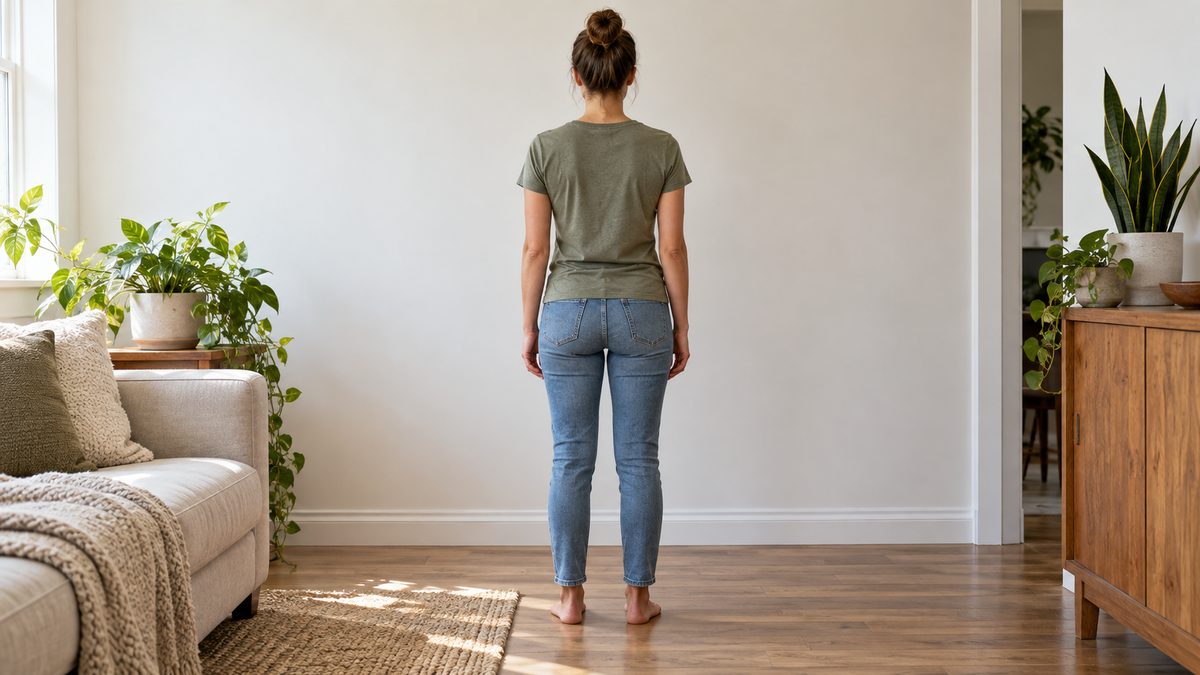
Good posture looks comfortable and adaptable: your head balances over your body, your shoulders stay relaxed and your joints are not forced into position. Sitting or standing well should let you breathe and move easily, rather than require a rigid pose.
A photograph only captures a moment. Someone can look upright while clenching their back, or sit slightly rounded while feeling comfortable. Use appearance as a starting point, then check effort, comfort and your ability to change position.
Standing comfortably without pulling yourself straight
Start with your feet a comfortable distance apart and your weight spread across them. Let your knees remain easy rather than pushing them backwards. Allow your arms to hang and your shoulders to settle instead of squeezing your shoulder blades together.
Your head should feel balanced, with your gaze towards the task in front of you. Avoid lifting your chin to appear taller. Your spine has natural curves, so a lower-back curve is not automatically a fault that needs flattening.
Try taking a few relaxed breaths. If you have to brace your abdomen hard or hold your breath to keep the position, soften it. Read comfortable standing habits for ways to adapt when cooking, queuing or talking to someone.
A wall check is a comparison, not a diagnosis
Choose a clear wall and stand with your heels a short, comfortable distance away. Have a steady support nearby if balance is uncertain. Skip the check if standing against the wall hurts or you have been told to restrict movement.
- Let your bottom and upper back meet the wall lightly, wherever comfortable.
- Keep your gaze level. Allow your head to approach the wall only if it can do so without tipping your chin or straining.
- Notice the space behind your waist without pushing your back flat or making a bigger arch.
- Step away and see if you can keep the same easy breathing while walking.
There is no required gap size or contact point that proves you have good posture. Body shape, spinal curves and mobility vary. If your head does not touch, do not press it back or ask another person to push it. A new or painful change in shape needs assessment rather than a wall test.
At a desk, start with the task and the chair
Sit far enough back to use the backrest, with your feet supported by the floor or a stable footrest. Your knees need room to move. Bring your keyboard and mouse close enough that you can work without holding your elbows far in front.
Place the screen where you can read it without leaning towards it or lifting your chin. Adjust text size before trying to hold your head still. If the chair is too high for your feet, lowering it may help, but check that the desk then remains usable.
A slight recline can be comfortable when the backrest supports you and you can still reach the task. Sitting upright is another option. The desk sitting guide explains the relationships between seat, work surface and screen.
| What you notice | Adjustment to try | What to check next |
|---|---|---|
| Shoulders lifted towards ears | Bring the task closer or lower the arm support | Can your arms rest without pushing upwards? |
| Feet dangling | Lower the seat or add firm foot support | Can you still reach the desk comfortably? |
| Chin reaching forwards | Make text larger and review screen distance | Can you read without leaning? |
| Back held stiffly arched | Ease the effort and use the backrest | Can you breathe and turn freely? |
Let posture change with what you are doing
Leaning forwards to tie a shoelace and bending to pick up clothing are ordinary movements. A posture that suits typing will not suit every task. The aim is to match the position to the activity and avoid staying somewhere uncomfortable simply because it looks correct.
Use natural pauses to vary your position: stand after a call, walk to refill a drink or change your sitting angle between tasks. There is no universal timer that makes a posture safe for everyone. Our ideas for sitting breaks can help you build movement into an ordinary day.
If you keep returning to an awkward position, change the surroundings first. Bring a phone closer, move a frequently used item or improve the lighting. Repeatedly reminding yourself to sit straight will not fix a screen you cannot see.
When a change in posture deserves medical advice
This is general information, not an assessment of your spine. Arrange medical advice for persistent or worsening pain, a new unexplained change in posture, fever or pain following an injury. A clinician can consider symptoms and function together rather than judging a photograph.
Seek emergency help for back pain with new difficulty passing urine, loss of bladder or bowel control, numbness around the genitals or bottom, or weakness or numbness in both legs. Use local emergency services in the US, UK or India. See back pain warning signs and when to get help.
Frequently asked questions
Can I judge my posture from a mirror selfie?
A mirror can show your position at that moment, but camera angle and how you pose affect the result. It cannot identify the cause of pain or tell you which exercises you need.
Should I keep my stomach pulled in while walking?
You do not need to hold your abdomen tightly throughout a walk. Let breathing remain easy and choose a pace you can manage. Follow individual instructions if a clinician has given you a specific exercise.
Does a rounded upper back mean I have failed at posture?
No. Spinal shape varies and can change for reasons beyond habit. A new curve, a rapid change or associated pain warrants professional assessment rather than repeated attempts to force yourself straighter.
Can someone else check my shoulders for me?
They can describe what they see, but uneven shoulder height alone is not a diagnosis. Ask them to observe rather than push or reposition you. Persistent symptoms are a better reason to seek an assessment.