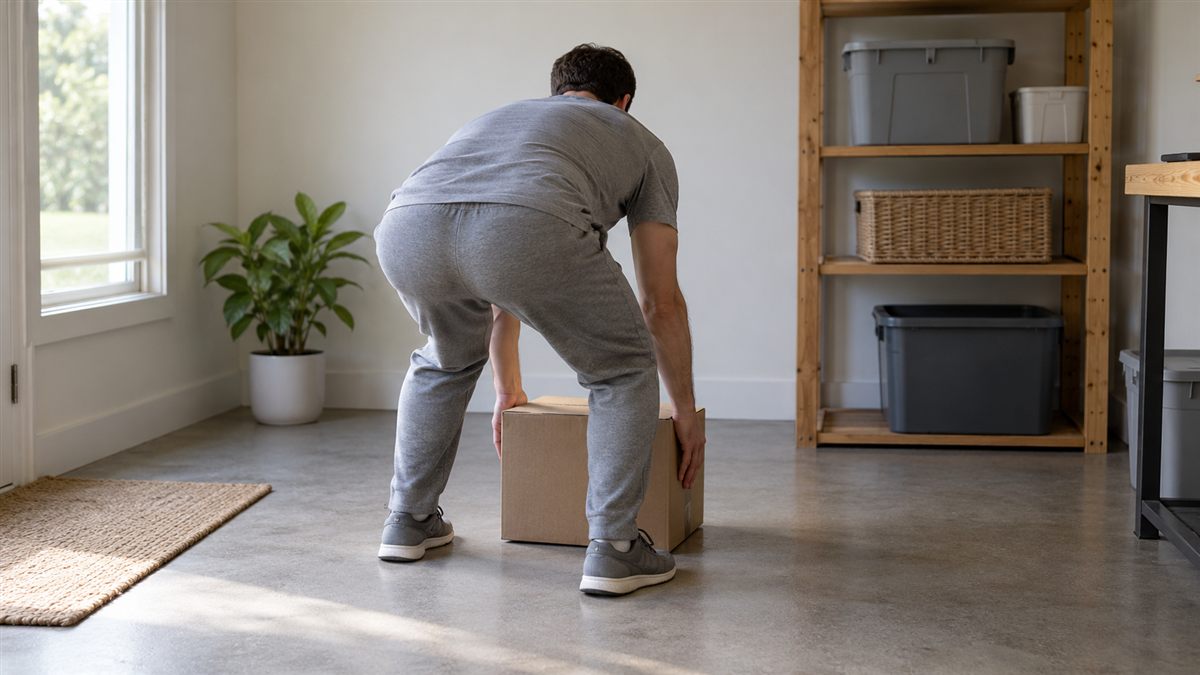
Start with the decision before the movement
A safe lifting plan begins before your hands touch the object. Ask if it can stay where it is, slide on suitable equipment or move in smaller parts. A large box may contain several light items that are easier to carry separately. A washing machine, loaded cabinet or bulky mattress may require trained help and proper equipment even when the distance is short.
Weight is only one part of the problem. A slippery surface, poor handholds, shifting contents and an object that blocks your view can make a modest load difficult. Your energy, balance and any current symptoms matter too. Avoid judging the task by what you lifted months ago or by another person's ability. The useful question is how to complete this particular move with control today.
Prepare the route and landing place
Open doors, move loose rugs and clear cables before lifting. Decide where the object will be placed, and make room for your fingers as you lower it. On stairs, narrow landings or wet floors, ordinary household carrying can become much harder. Changing the route or waiting for assistance may be the better choice.
If the destination is a high shelf, consider a lower storage location. Repeatedly lifting a heavy item above shoulder level adds difficulty that a technique cue cannot remove. Store frequently used objects where they are easy to reach. For tasks that combine carrying, wiping and repeated bending, the household chores guide shows how changing the setup can reduce unnecessary effort.
Bring yourself close before you lift
Stand near the object with enough space for your feet. Choose a stable, comfortable stance and bend through your hips and knees as much as the task requires. A deep squat is not essential for every lift, and forcing one can make an awkward object harder to handle. Aim for a position from which you can grasp the load without reaching far forwards.
Keep the object close as it leaves the surface. Move smoothly rather than jerking it upwards, and allow yourself to breathe. If you need a sudden heave or find yourself holding your breath hard, reconsider the task. Put the object down in a controlled way if you can do so safely. Technique cannot make an unsuitable load appropriate for one person.
Move the load without rushing
Look along the route and take steps that let you keep control. When changing direction, move your feet instead of planting them and twisting sharply through your middle. Keep the item from drifting out in front of you. If it begins to slip or you lose a clear view, stop in a safe place and reassess rather than hurrying to finish.
Plan pauses for longer carries. A clear surface at a suitable height may let you set the load down before continuing. Avoid resting a heavy box on an unstable chair or balancing it on your knee while opening a door. Carrying with one hand can sometimes be necessary, but reduce the load and distance. Read how to manage a heavy bag for everyday commuting examples.
Coordinate help and equipment properly
Two people should agree on who gives the movement signal, where each person will hold and how to put the item down. Similar expectations matter more than counting on one stronger person to rescue the lift. Walk through the route first, especially when a person moving backwards cannot see the floor. Stop if communication becomes difficult.
A trolley should suit the load and surface. Check its condition, secure the item as intended and avoid improvising on stairs. At work, follow the employer's manual-handling procedures and ask for training or equipment when required. The OSHA ergonomics resource provides a general starting point for workplace task design. Local workplace rules and task-specific training still apply.
Run through a lifting checklist
Before a difficult carry, give yourself permission to change the job. The checklist below focuses on decisions you can make without calculating a universal weight limit. No single limit accounts for every person, object, height and working environment.
- Can the contents be divided or the route shortened?
- Are the floor, handholds and destination ready?
- Can I keep the load close without blocking my view?
- Would suitable equipment or another person improve control?
- Do I have a safe place to pause and lower the object?
A delivery at the door is a useful example of planning under pressure. You do not have to carry a sealed box directly to its final room. If the contents allow it, open the packaging safely and make several smaller trips. Keep children and pets away from the route while moving large objects. If you live alone, arrange assistance in advance for furniture or appliances instead of waiting until an item blocks the entrance and the decision feels urgent.
Recover and review the task afterwards
After an unfamiliar carrying job, avoid immediately adding another long block of demanding chores. Change position, take a comfortable walk and notice how you feel. If the same task repeatedly leaves you sore, review storage height, load size and frequency. A better arrangement may prevent the need to repeat a difficult lift in the first place.
General strength and control exercises can complement sensible task planning, but strength does not remove the need for help. New severe pain after an injury, weakness, numbness or other concerning symptoms deserve medical assessment. Use the back pain warning-sign guide if you are unsure about urgency, and avoid using repeated lifts to test a painful back.