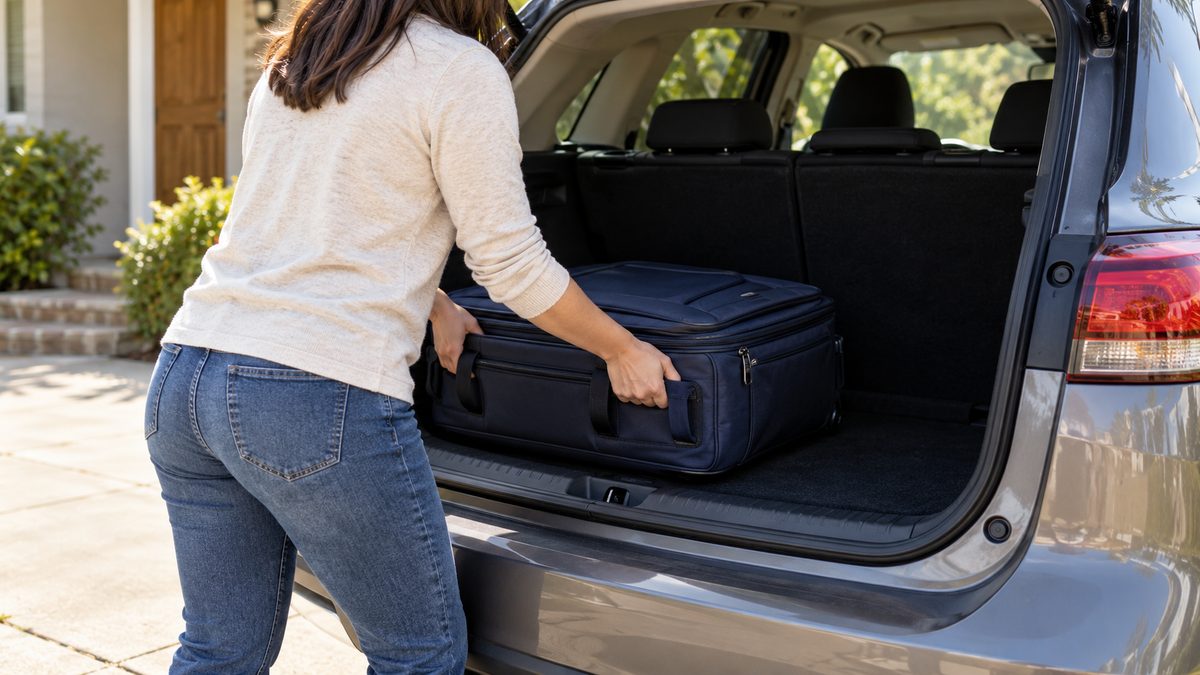
Use luggage you can control throughout the lift, keep it close for as much of the movement as possible and arrange help before an overhead lift becomes a struggle. A wheeled case can still be too heavy to lift safely. Packing less is often the most useful adjustment.
A suitcase may travel smoothly through a terminal but become awkward at the aircraft doorway or a deep car boot. You are dealing with height, limited space and other people as well as weight. Plan for those moments before leaving home.
Test the packed case where you can put it down
Close the case and check its carrying handles, zip and balance. With clear space around you, try lifting it a small distance using the intended handle, then set it down under control. Stop if the grip slips or you need a sudden heave. Do not test an uncertain load above your head.
A case that meets a baggage allowance is not necessarily manageable for you. Check your carrier's official baggage information for current dimensions, weight rules and permitted storage. Those rules describe what can travel; they do not assess your strength, reach or shoulder movement.
Remove items you do not need and distribute essentials sensibly. Put dense items where they will not shift, and avoid loose objects dangling from the handle. Keep travel documents accessible so you do not have to unpack while blocking an aisle.
Arrange overhead help before the aisle fills
If you cannot confidently lift and lower your case, contact the carrier about assistance options before travelling. Do not assume cabin staff can lift it for you. Tell a travelling companion what help you need and decide who will guide the case into place.
At boarding, wait until the space is clear rather than lifting over someone's head. Check the bin opening and follow crew directions about orientation and storage. Do not stand on a seat or armrest to gain height. If you cannot reach from stable footing, ask about another permitted arrangement.
With a case you can manage, face the opening and establish a secure grip using the carrying handles. Keep the load close until the space requires it to move away. Use a smooth movement, step to turn and avoid arching back to force the last part of the lift.
Check each transfer, not just the first lift
| Transfer | Check before moving | Change the plan if |
|---|---|---|
| Floor to carrying height | Handles are secure and your feet have room | You must jerk the case upwards |
| Into an overhead bin | Opening is clear and the case is controllable | You lose grip or must lean far backwards |
| Out of an overhead bin | People are clear and you can support the descent | The case has shifted or is wedged |
| Across a car boot lip | There is a clear landing space near the edge | You must reach over other bags |
| From a deep boot | The case can come closer before lifting | Your feet stay planted while your body twists |
If sharing a lift, agree who starts, where the case will land and when to lower it. Two people pulling in different directions can make the load less predictable. The principles in lifting heavy things also apply to luggage transfers.
Make the car boot a short reach
Park where you have safe access and stable footing. Clear the boot before bringing the case over. Lift over the lip into a space near the edge, then reposition the case if this can be done without a long unsupported reach. Watch fingers around handles and hard edges.
When unloading, bring an accessible case towards the edge before lifting it out, provided it can move without snagging or tipping. Stand close, use both hands where possible and step away with the load before turning. Do not balance it on a loose parcel shelf.
If the boot is too deep or high for you, arrange another person or a different packing order. Keep the case you will need first accessible. Secure luggage appropriately for the journey and avoid putting heavy bags where they can move into the passenger area.
A luggage trolley can reduce carrying between transfers. Check that it rolls freely and that bags do not block your view. For smaller bags, the heavy bag advice explains why the total load still matters even when it is split.
Leave enough energy for unloading
Getting a case down after a long flight may feel harder than putting it up. Wait for space, check whether it has moved and request agreed help before releasing its support. Do not tug a stuck case towards your face or try to catch a falling bag.
During the journey, use opportunities for comfortable movement when conditions allow. After arrival, take a moment before another transfer rather than lifting while stiff, rushed or unsteady. Our travel posture guidance covers the sitting between these handling tasks.
Stop the transfer if symptoms change
This is general handling guidance. If pain or weakness makes you lose control, put the case down safely and get help. Seek prompt medical advice for severe or rapidly worsening pain, fever, or new limb weakness. A serious fall or impact requires urgent assessment.
New bladder or bowel difficulties, numbness around the bottom or genitals, or symptoms in both legs need emergency care. The back pain warning signs guide explains when travel plans should give way to medical assessment.
Frequently asked questions
Can I use the extendable trolley handle to lift the case?
Use a carrying handle designed for lifting and check the luggage instructions. An extendable pulling handle may not be intended to support a loaded case in the air. A damaged or loose handle is a reason to change the bag or get suitable help.
Is a small backpack always easier than a cabin suitcase?
No. A small bag can still be heavy, and a backpack needs to suit your shoulders and the journey. Compare the packed load and the transfers you will face. Storage permissions also vary, so check the carrier rather than assuming a bag can go anywhere.
What should I do if someone asks me to lift their case?
You can decline a lift you cannot control. Ask them to arrange appropriate assistance rather than attempting it because people are waiting. If you agree to help with a manageable bag, establish its weight, grip and destination before either person starts.
Should I try lifting after recent back or shoulder surgery?
Follow your surgical team's lifting restrictions and discuss travel handling before departure. General luggage advice cannot set a safe weight or overhead range after surgery. Arrange help for every transfer, including the return trip, rather than testing your recovery at the airport.