Exercises for better posture can help you practise comfortable movement and build activity into a desk day. A useful starting routine combines gentle neck and shoulder movements, upper-back movement and controlled standing from a chair; it does not need to force your spine into a fixed shape.
The repetitions below are suggested starting amounts, not a treatment dose or a promise of correction. Do fewer if needed. If you have an injury, recent surgery, a diagnosed spinal condition or restrictions from a clinician, ask which movements suit you before starting.
Clear a space and check how you feel first
Use a firm chair that will not roll or slide, and leave enough room to stand. Wear clothing that allows movement. Begin with an easy walk around the room, then notice any symptoms you already have so you can recognise a change.
Work within a range that feels comfortable. Mild muscular effort is different from a sharp pain, a spreading ache or tingling. Do not use momentum to reach farther. You should be able to breathe throughout, and you can leave out any exercise that does not suit you.
Five movements to try between desk tasks
| Movement | Starting amount | Main form cue |
|---|---|---|
| Small chin nod | 5 slow repetitions | Nod gently without pushing the head back |
| Shoulder blade glide | 6 repetitions | Keep shoulders away from ears |
| Seated upper-back turn | 4 each way | Turn only as far as breathing stays easy |
| Wall slide | 5 repetitions | Stop before the lower back arches |
| Sit to stand | 5 repetitions | Rise smoothly with feet steady |
Small chin nod
Sit with your back supported and look forwards. Make a tiny nod as if starting to look down, then return to your usual position. Keep your jaw loose. This is a small movement, so there is no need to make a double chin forcefully or press your head against anything.
Shoulder blade glide
Rest your hands on your thighs. Move your shoulder blades gently towards one another, without lifting your shoulders or pushing your chest out. Let them return fully between repetitions. If you feel your lower back tightening, reduce the effort and use the chair for support.
Seated upper-back turn
Keep both feet on the floor and place your hands across your chest or on your thighs. Turn your chest a small distance to one side, return to the middle and try the other side. Let your head follow comfortably. Do not pull on the chair to increase the turn.
Wall slide
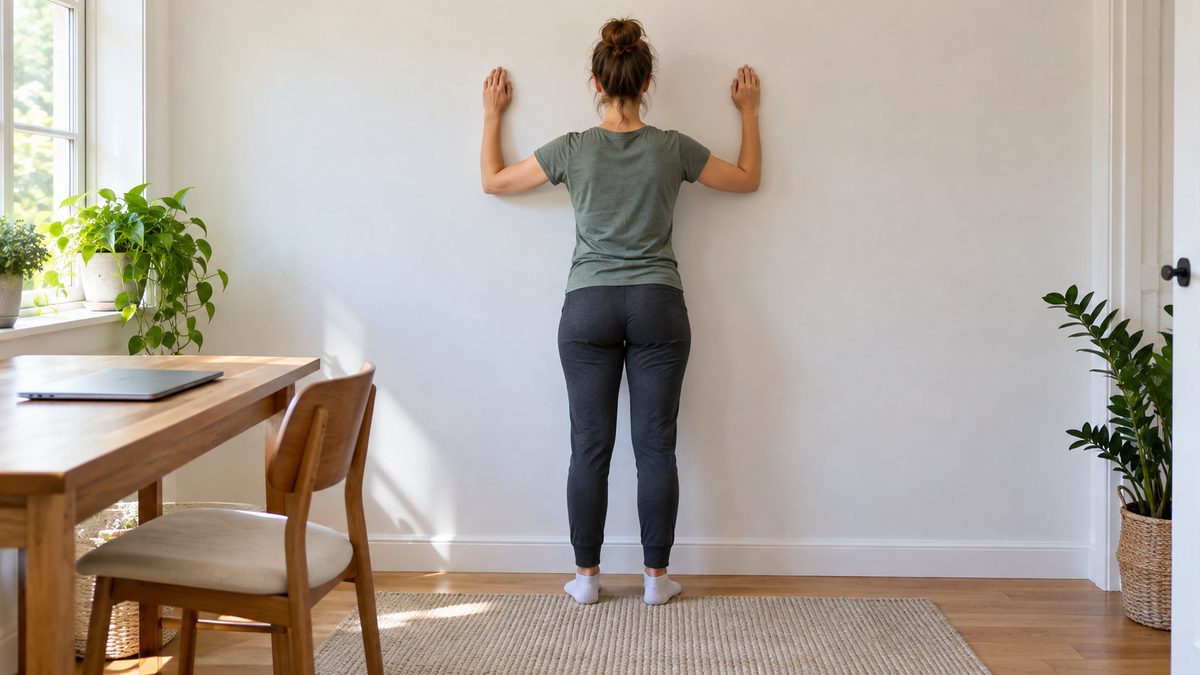
Face a clear wall and place your forearms against it, with elbows at a comfortable height below your shoulders. Slide your forearms upwards a little, then return. Stop before you shrug, lean into the wall or arch your lower back. Your arms do not need to reach overhead.
Sit to stand
Move towards the front of the stable chair and bring your feet underneath you. Lean forwards from the hips, push through your feet and stand. Sit down slowly with control. Use the armrests if needed; using support is a sensible adaptation, not a failed repetition.
If standing is difficult, practise with a physiotherapist before repeating it alone. A chair placed securely against a wall may reduce sliding, but it must still be strong and suitable for the task.
Choose the version you can repeat comfortably
You can do one circuit, or spread the movements across several breaks. Do not add repetitions just to complete a number if your form changes or symptoms begin. For more seated options, see gentle upper-back and neck movements.
If the movements feel easy during and afterwards, try a little more on a later day, changing one thing at a time. That might mean another repetition rather than a deeper stretch. If you are more uncomfortable later, reduce the amount or pause and seek advice if symptoms persist.
Keep a brief note of the exercise, how it felt and any later symptoms. This is more useful than judging progress from a photograph. Comfort with everyday tasks and confidence moving are practical things to discuss with a clinician.
Give the routine somewhere useful to fit
Attach a movement break to an existing event, such as finishing a meeting or sending a piece of work. Keep ordinary walking in your day too. The walking and back health guide offers another way to vary desk work without turning every break into a workout.
Review the workstation alongside exercise. If your mouse is out of reach or your feet cannot rest, you may keep returning to an uncomfortable position. Use the desk ergonomics checklist to identify a practical adjustment. Exercise cannot make an unsuitable setup comfortable indefinitely.
Symptoms that mean the routine should stop
Stop for sharp or increasing pain, dizziness, new tingling, numbness or weakness. Do not repeatedly test a movement that sends pain down a limb. Seek medical advice for recurring symptoms, worsening pain, fever or pain after a fall.
New bladder or bowel changes, loss of feeling around the genitals or bottom, or symptoms affecting both legs with back pain need emergency assessment. This routine is general guidance, not treatment. Read when back pain needs a doctor before trying to exercise through unexplained symptoms.
Frequently asked questions
Can I do these movements in work clothes?
Yes, if your clothes allow free movement and your shoes give you steady footing. Skip floor work in a cramped office and choose a stable chair rather than balancing on a swivel seat.
Should I add hand weights straight away?
Start without extra load so you can judge the movements and your response. If you want to add resistance, ask for guidance when you have pain or a health condition that affects exercise.
What if I only have time for one movement?
Choose a comfortable movement that fits your space, then walk or change position when possible. There is no requirement to finish the whole circuit each time you leave the keyboard.
Do I need to feel a stretch for the routine to count?
No. A comfortable movement can be useful practice without a strong stretching sensation. Chasing a bigger sensation can make you push beyond a range you tolerate.